Korea Entry OS
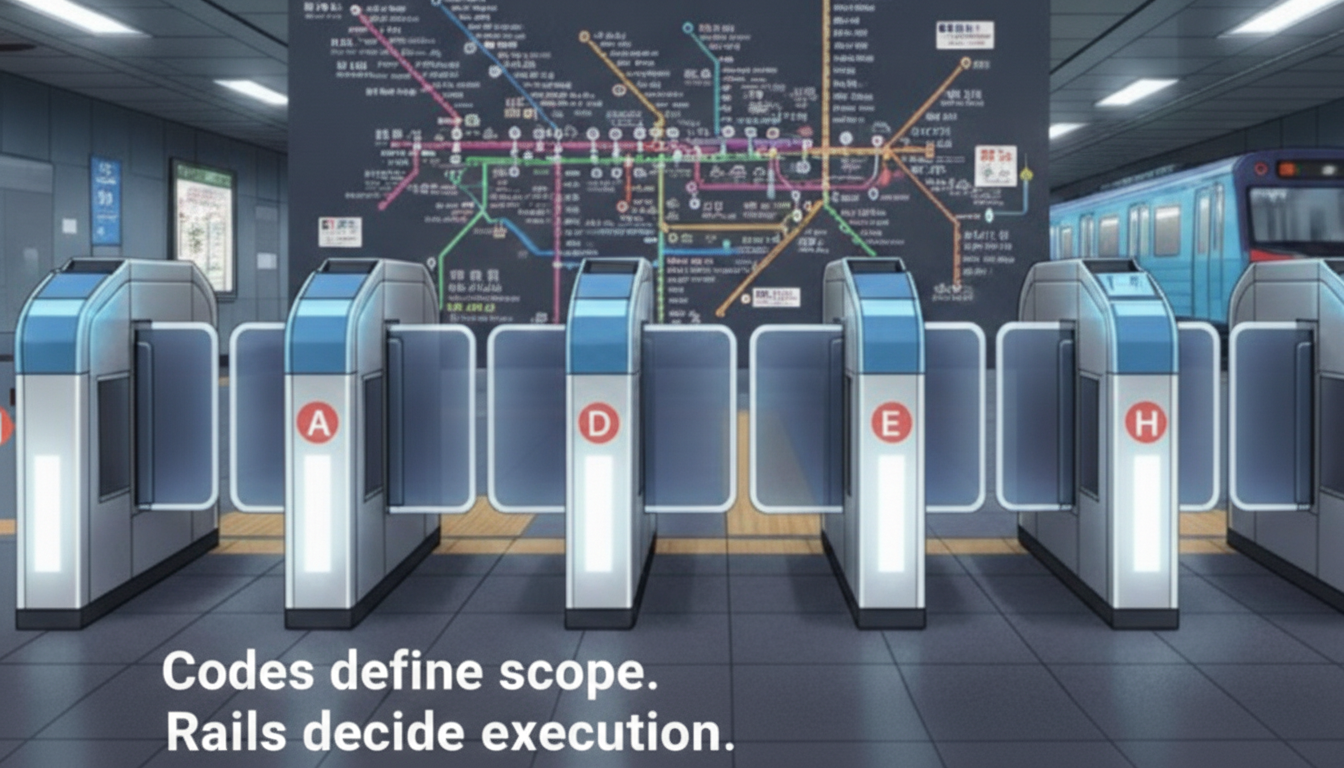
Status of Stay + Three Participation Rails
For anyone planning to stay in Korea for more than a month, “entry” is not simply about obtaining permission. Two layers operate simultaneously:
- Codes define what you are allowed to do.
- Rails determine whether you can actually do it.
If you don’t fix this structure in advance, the process collapses into endless searching instead of a designed transition.
0m — Terms to Fix First
Status of Stay (Code)
Korea operates permitted activities through coded categories (study, employment, research, investment, residence, etc.). Public listings by the Seoul Metropolitan Government show broad classifications (A–H) as a map of activity scope.
| Category | Functional Meaning | Notes |
|---|---|---|
| A | Public / Diplomatic | Official and governmental functions |
| C | Short-term Stay | Covers temporary visits; no separate B axis required |
| D / E | Purpose-Based Activities | Study, training, employment, professional work |
| F | Residence / Long-term Settlement | Permanent or quasi-permanent stay categories |
| H | Special Programs | Working holiday and similar structured programs |
Note: There is no “B” category in Korea’s current status-of-stay classification.
Extension
Permission to remain longer before your current authorized stay expires; the rule and penalties are codified.
Change of Status
Permission required when your primary activity changes (e.g., study → employment). This is a legal requirement, not a semantic nuance.
Zoom 0 — The Entry Rules
K-ETA, Visa-Free Entry, and Immigration Inspection
Three facts:
- K-ETA is not a visa. Approval does not guarantee admission. Final determination rests with immigration inspection.
- Temporary K-ETA exemption for certain nationalities (including Germany) has been extended until December 31, 2026, announced by the Embassy of the Republic of Korea in Germany.
- The same extension appears on VisitKorea (German).
Entry permission is conditional. Inspection remains sovereign.
Digitalized Entry: e-Arrival Card
The electronic arrival declaration (e-Arrival Card) has been implemented as of February 24, 2025.
- Paper forms remain available until the end of 2025 during the initial phase.
- Submission opens 3 days prior to arrival (KST).
Digitization does not remove discretion. It standardizes intake.
Zoom 1 — Replace “Why Are You Coming?” With Variables
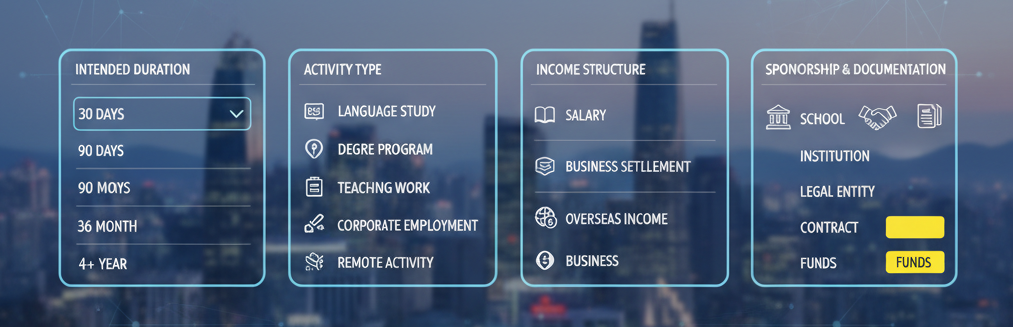
Without clarifying income structure, status design is impossible.
Zoom 2 — Status Categories as a Coordinate System
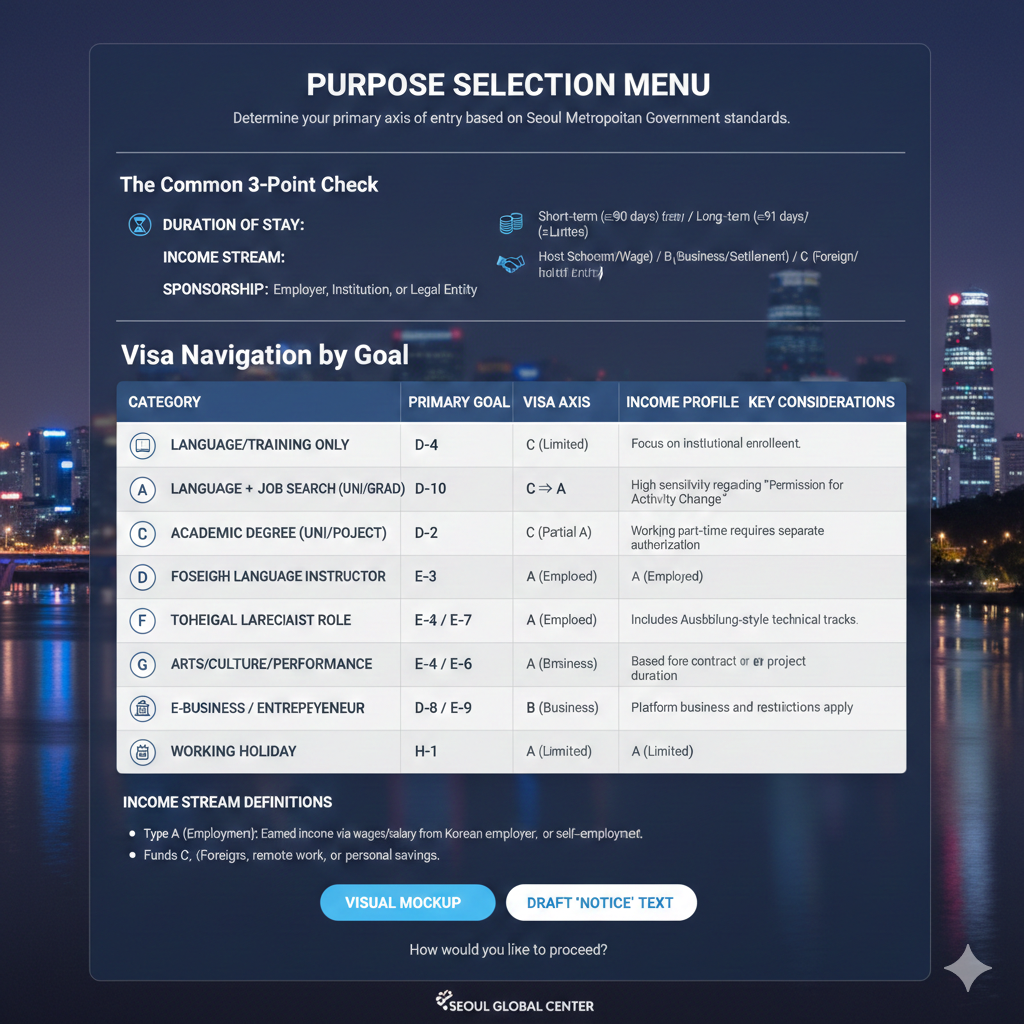
| Category | Primary Goal | Visa Axis | Income Profile | Key Considerations |
|---|---|---|---|---|
| A | Language / Training Only | D-4 | C (Study/Training; work is prohibited in principle) |
Institutional enrollment is the core proof basis. Part-time work is not the default; permission may be required under “activities outside status of stay,” subject to conditions. |
| B | Language + Job Search | D-10 | C (Job seeking) → A (only if part-time permission is granted) |
High sensitivity regarding authorization/permission when changing activities or adding paid activities. Part-time employment is conditional (eligibility requirements apply) and requires prior permission. |
| C | Academic Degree (Uni / Grad) | D-2 | C (Study) → Partial A (part-time only with prior permission) |
Part-time work requires separate authorization and compliance with permitted fields/hours. Activity beyond the permitted scope can trigger sanctions. |
| D | Research (Institution / Project) | E-3 | A (Employed) | Scope is tied to research role/field and the sponsoring institution or contract structure. |
| E | Foreign Language Instructor | E-2 | A (Employed) |
Defined as foreign-language conversation instruction; activity scope is occupation/status-defined. Work outside the status generally requires prior permission. |
| F | Technical / Specialist Role | E-4 / E-7 | A (Employed) | Occupation-designated technical/specialist placements; requires employer sponsorship and role alignment with status scope. |
| G | Arts / Culture / Performance | D-1 / E-6 | A / B (Contract / Project-based) |
Typically structured around contracts, projects, or performance engagement periods. Settlement structure (who pays, where income accrues) matters for classification and compliance. |
| H | Corporate Employment (High-skilled placement) | E-7 | A (Employed) |
“Designated activities” status; professional/semi-professional categories apply. Employment contract and role alignment with designated scope are central. |
| I | e-Business / Entrepreneur | D-8 / D-9 | B (Business settlement) |
Business/investment/trade-management structure is the core variable. Proof often relates to investment/trade registration and operational capability. |
| J | Working Holiday | H-1 | A (Limited; depends on bilateral agreement) |
Eligibility and conditions are “as specified in Agreement” with partner countries. Confirm country-specific limits (age/quota/allowed activities) via official notices. |
Source anchors: Seoul Metropolitan Government (visa categories), Korea Immigration Service “VISA NAVIGATOR” (definitions/eligibility), EasyLaw (D-2/D-4 part-time rule summary).
This is not a catalog. It is a coordinate system of permitted activity.
A status code defines your legal scope. Nothing more. Nothing less.
Zoom 3 — Korea’s Participation Rails:
The Three-Layer Structure
What many perceive as “inconvenience” usually emerges not from status codes, but from rails. Rails are not psychological barriers. They are infrastructural conditions for contracts and settlement.
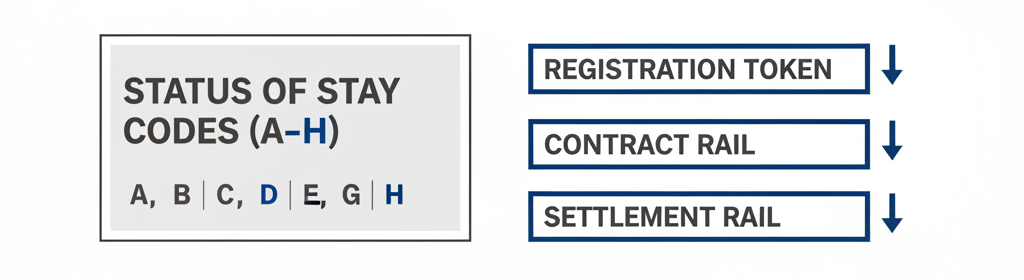
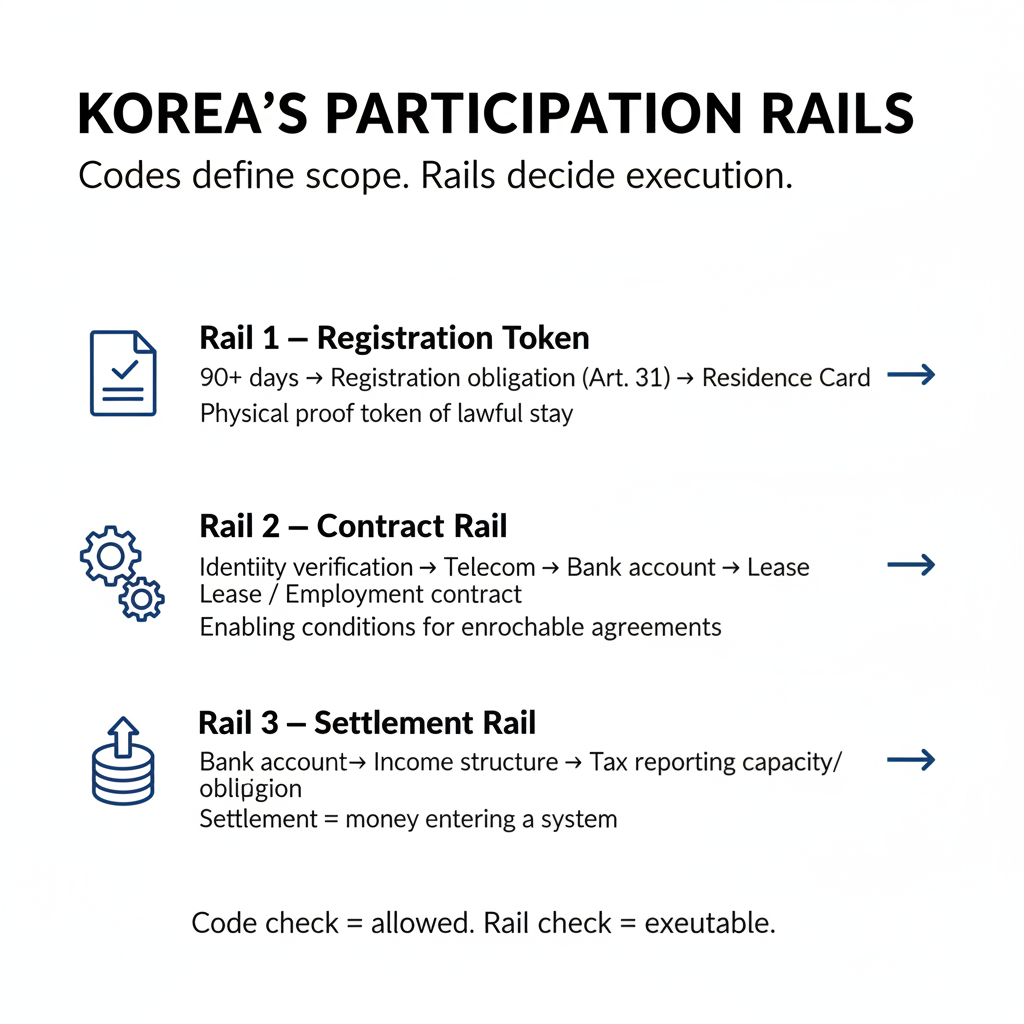
Checking the code tells you what is allowed. Checking the rails determines whether it can actually operate.
Sidebar — Purpose Input Menu (Representative Coordinates)
Platform Markets: Not Technology — Structure
Platform markets are often described as technological innovation. The OECD frames them as digital intermediation models and links their rise to digital technologies and new business models, alongside platform-mediated work (gig/crowd work, etc.).
But for entry design, the relevant question is not technology. It is:
- Where does income legally accrue (Korea / overseas)?
- Who performs settlement (Korean platform / foreign platform / foreign employer)?
- Does the activity fall within permitted scope under your status code?
A platform is not a job title. It is a settlement structure.
If settlement occurs inside Korea, interpretation risks around “domestic profit-making activity” can arise.
10m Execution — Follow Time Order Only
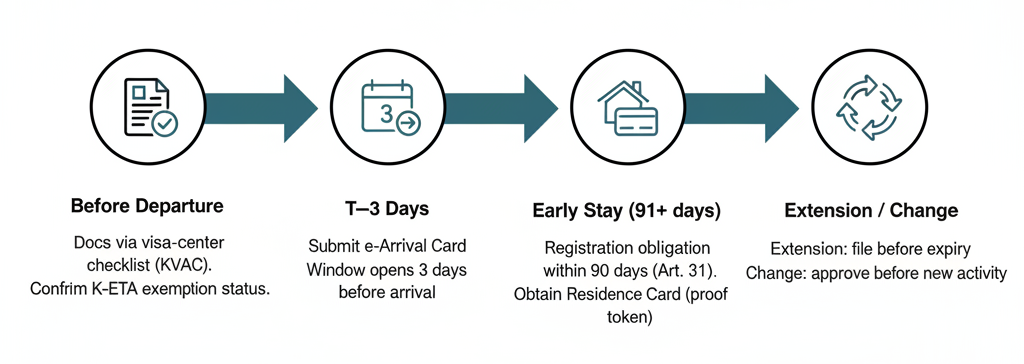
Korea does not operate on permission alone. It operates on a layered system:
- Status Codes define scope.
- Participation Rails enable execution.
Entry is not crossing a border. It is connecting to a system.
If you understand both layers, the process becomes design. If you understand only one, it becomes friction.
References (Institution List for Readers)
- Korea Electronic Travel Authorization (K-ETA) — Official Site — K-ETA overview and application portal.
- Korea Immigration Service (Ministry of Justice) — K-ETA Information — “K-ETA is NOT a visa; approval does not guarantee admission; final determination at port of entry.”
- Embassy of the Republic of Korea in Germany (MOFA) — K-ETA Exemption Notice — Temporary K-ETA exemption extension (through Dec 31, 2026).
- VisitKorea (German) — K-ETA Exemption Extension — Extension notice (through Dec 31, 2026).
- Official e-Arrival Card Website — Submission window (within 3 days before arrival).
- MOFA (Consulate Notice) — e-Arrival Card Implementation — Implemented from Feb 24, 2025; online submission starting 3 days before arrival.
- National Law Information Center (law.go.kr) — Immigration Act, Article 31 — Registration of aliens (90+ days stay → registration duty).
- Seoul Metropolitan Government — Visa / Status Categories (A–H) — Public list of status categories and representative codes.
- EasyLaw (Korea) — Extension / Change of Status Rules & Sanctions — Procedural requirements and penalties for noncompliance.
- OECD — Regulating Platform Work in the Digital Age (PDF) — Platform intermediation model + platform-mediated work framing (gig/crowd work).
Accessed: 2026-02-17
Dawn Chang, PhD · Editor-in-Chief, K-Welle · editor@k-welle.com


![How Cost & Accessibility Shape City Choice for Gen Z [Vol 2.]](/content/images/size/w720/2026/02/nano-banana-2026-02-03T10-53-01-1.png)