K-Housing as Mobility Constraint
How Housing Choices Shape Mobility, Risk, and Opportunity
For many European Gen-Z visitors planning a stay in Korea, housing is often approached as a simple lifestyle decision. In reality, it operates very differently.
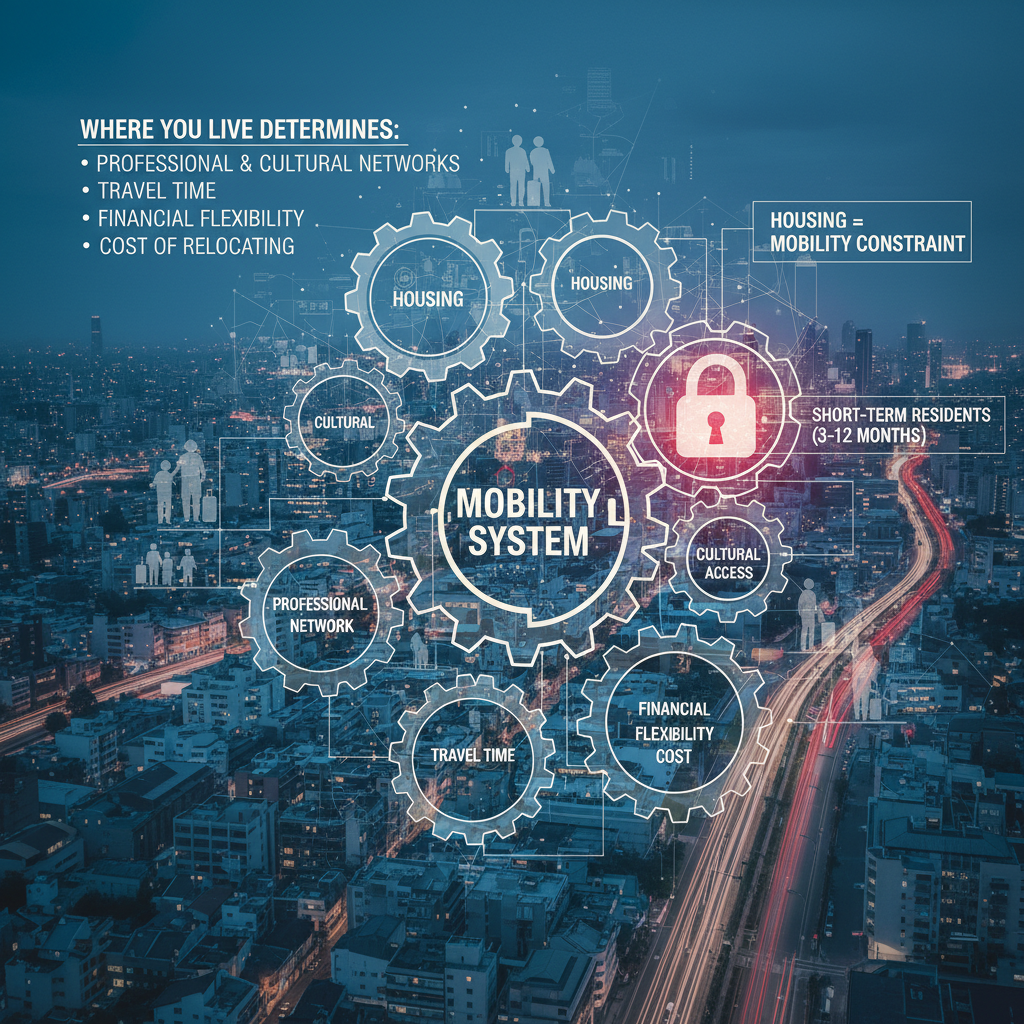
Within the Korea Experience OS, housing functions as part of the country’s mobility system. Where you live determines not only daily comfort, but also:
- access to professional and cultural networks
- travel time across the city
- financial flexibility
- the cost of relocating if plans change
For short-term residents (3–12 months), housing therefore becomes a mobility constraint.
The real decision is not simply:
“Where should I live?”
but rather:
“How reversible is this housing decision if my plans change?”
Understanding this requires a framework that evaluates both mobility and risk.
Mobility × Recoverability: A Framework for Housing Decisions
Short-term residents face two structural variables when choosing housing in Korea.
Mobility refers to how easily a location connects you to opportunities, transport networks, and social hubs.
Recoverability refers to how easily you can relocate if the decision turns out to be wrong.
Together, these variables form a simple matrix.
| High Recoverability | Low Recoverability | |
|---|---|---|
| High Mobility | Co-living in central Seoul | Private studio with large deposit |
| Low Mobility | Co-living in suburbs | Long-term lease in suburbs |
The safest entry point for newcomers is usually:
High Mobility + High Recoverability
This allows residents to explore the city without locking themselves into high switching costs.
To evaluate this in practice, four indicators are particularly important.
Four Indicators That Predict Housing Risk
1. Deposit Lock-In
The size of the deposit determines how much capital becomes locked into the housing contract.
- small deposit → easier relocation
- large deposit → high switching cost
This factor is especially significant in Korea due to the country’s unique housing system.
2. Contract Flexibility
Lease duration directly affects mobility.
| Contract Type | Flexibility |
|---|---|
| Short-term rental | high |
| Monthly contract | moderate |
| One-year lease | low |
Shorter contracts increase recoverability.
3. Mobility Access
Mobility depends heavily on transport infrastructure.
Key variables include:
- proximity to subway lines
- commute time to central Seoul
- access to major mobility corridors
A lower-rent location can still impose high mobility constraints if transport access is weak.
4. Network Density
Economic and social opportunities in Korea are geographically concentrated.
Areas with higher density provide easier access to:
- universities
- startups and companies
- creative communities
- international networks
Housing decisions therefore shape the network environments residents interact with daily.
Why Korea’s Housing System Creates Lock-In
Korea’s housing market differs significantly from most European systems because of the deposit-based rental structure.
The most distinctive feature is the jeonse system, which requires tenants to pay a large deposit instead of monthly rent.
| Housing System | Structure | Mobility Impact |
|---|---|---|
| Jeonse | very large deposit, no monthly rent | very low recoverability |
| Monthly rent | deposit + monthly payment | moderate recoverability |
Jeonse deposits often reach 50% or more of property value, making them impractical for most short-term foreign residents.
As a result, temporary residents typically choose monthly rent or flexible housing options.
Housing Types and Their Mobility Risk
Different housing types vary mainly in their recoverability.
| Housing Type | Deposit | Monthly Cost (€) | Recoverability |
|---|---|---|---|
| Co-living / share house | 700–2,100 | 430–850 | high |
| Furnished short-term rental | low or none | 650–1,400 | high |
| Studio monthly rent | 2,100–7,100 | 500–850 | medium |
| Goshiwon | none or very low | 200–430 | high |
Interpretation:
- Co-living spaces offer the most flexible entry point
- Furnished rentals reduce initial friction but cost more monthly
- Private studios require higher deposits and longer commitments
- Goshiwon provides the lowest cost but limited space
Mobility Gradient: Seoul vs Other Korean Cities
Housing cost varies widely across Korean cities.
Average studio rent (city center)
| City | Monthly Rent (€) |
|---|---|
| Seoul | 500–900 |
| Suwon | 380–410 |
| Ilsan (Goyang) | 450–460 |
| Yongin | 470–530 |
| Busan | 340–570 |
| Daejeon | 300–380 |
Interpretation:
- Seoul offers the highest network density but also the highest housing cost
- Satellite cities near Seoul provide lower rent but reduced mobility
- Regional cities offer lower living costs but fewer professional opportunities
Lower rent does not automatically translate into better opportunity access.
Network Geography Inside Seoul
Within Seoul, different districts function as distinct urban network nodes.
| Area | Network Role |
|---|---|
| Hongdae | creative and youth culture hub |
| Shinchon / Ewha | university ecosystem |
| Itaewon | international community |
| Gangnam | corporate and business cluster |
| Seongsu | startup and design scene |
Choosing a neighborhood therefore affects which communities and opportunities are easiest to access.
Monthly Living Cost Example
Housing decisions should be evaluated together with overall living expenses.
| Category | Seoul | Busan | Daejeon |
|---|---|---|---|
| Studio rent | 700–900 € | 400–550 € | 320–430 € |
| Management fee | 30–140 € | 25–100 € | 20–80 € |
| Transport | 40–60 € | 30–50 € | 25–45 € |
| Food & living | 250–350 € | 220–320 € | 200–300 € |
Overall costs are highest in Seoul but significantly lower in regional cities.
Applying the Framework: How to Find Housing
Housing search in Korea typically combines digital platforms, local communities, and real-estate agents.
Online platforms
Private studios and apartments are commonly listed on
- Zigbang
- Dabang
These apps provide extensive inventories of rental properties.
Short-term furnished rentals are widely available through
- Airbnb
Community information
Housing information also circulates through expatriate communities.
Examples include:
- Facebook groups such as “Seoul Expats Housing”
- neighborhood communities like “Hongdae Foreign Residents”
- expatriate discussions on Reddit
These networks help newcomers understand realistic prices and neighborhood conditions.
Local real-estate agents
Traditional real-estate agents remain important in Korea’s housing market.
Foreign residents often work with foreigner-friendly agencies that provide:
- English contract explanations
- deposit and management-fee clarification
- assistance with lease documentation
Many properties still appear first through agents rather than online platforms.
On-site verification
Before signing a contract, visiting the area is strongly recommended.
Key factors to check include:
- distance to subway stations
- neighborhood amenities
- building condition
- noise and street activity
These details strongly influence the actual mobility of the location.
Practical Risk-Reduction Tips
Several simple checks can reduce housing risk.
Calculate the full cost structure
Total housing cost often includes:
- deposit
- monthly rent
- management fee
- utilities
- internet
Ignoring management fees can significantly distort the real monthly cost.
Start with high recoverability
New arrivals often benefit from beginning with:
- co-living spaces
- furnished short-term rentals
These options allow time to learn the city before committing to larger deposits.
Evaluate mobility, not just rent
Housing should be evaluated based on:
- transport connectivity
- commute time
- access to cultural and professional hubs
- international community presence
Lower rent may come with higher mobility constraints.
Conclusion
Housing in Korea is not simply about finding a place to live.
It is part of the country’s mobility infrastructure.
A housing decision influences:
- financial flexibility
- network access
- relocation costs
- everyday mobility
For short-term residents, the most important variable is not just rent level.
It is recoverability — the ability to change location without significant financial loss.
Understanding housing through the Mobility × Recoverability framework allows residents to evaluate risk more effectively and choose locations that preserve both flexibility and opportunity.