

From Navigator to the Engines: Mapping the Korean System
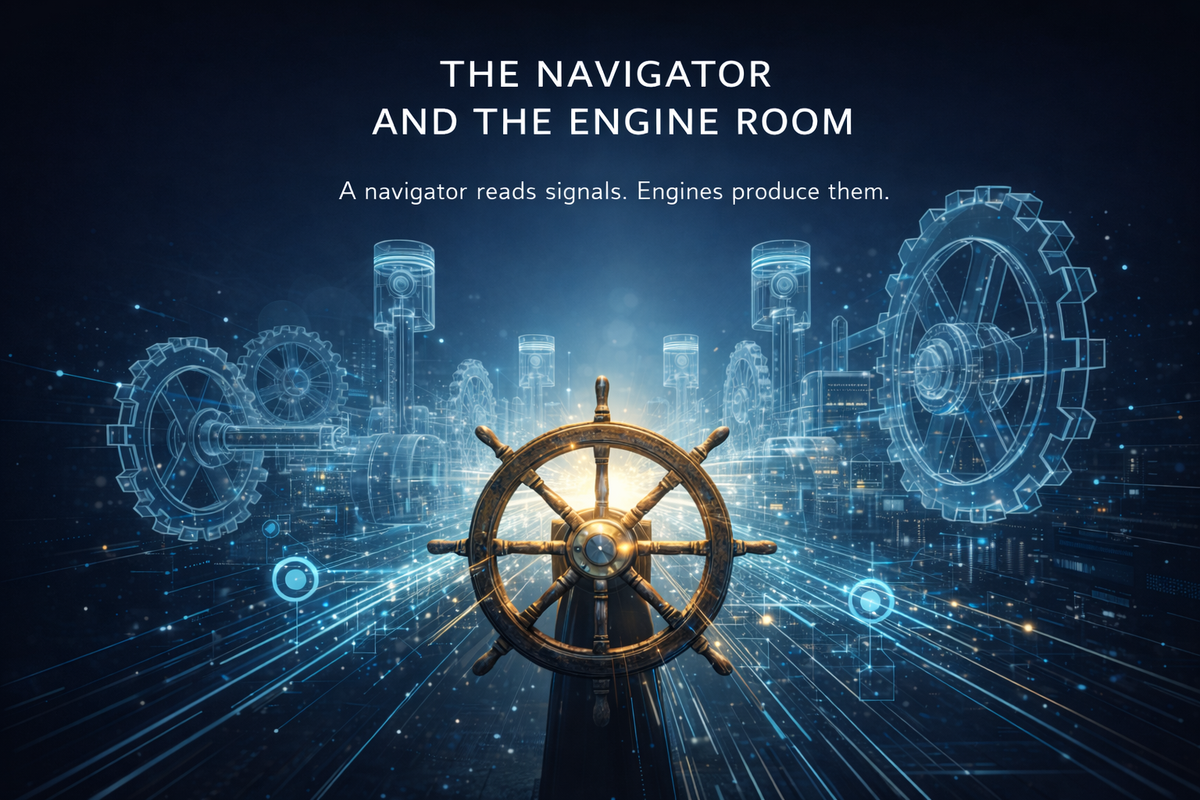
K-System Decode set a posture: Korea as a system, the reader as its navigator.
The first stage answered one question.
The reader finished able to decide whether Korea warranted the cost of learning a new navigation system.
This prologue opens the next question.
Because every system has producers behind it.
Who produces the talent the reader will compete with, work under, or hire?
Who operates the firms that issue hiring filters and supplier contracts?
Who decides that Pangyo becomes Code grammar and why those grammars persist for decades?
K-System Decode answered the navigator’s questions at the scale of the individual move.
The volumes that follow answer a different class of questions — at the scale of the engine.
Same system.
Same reader.
A longer lens.
The Navigator and the Engine Room
A navigator reads signals.
An engine produces them.
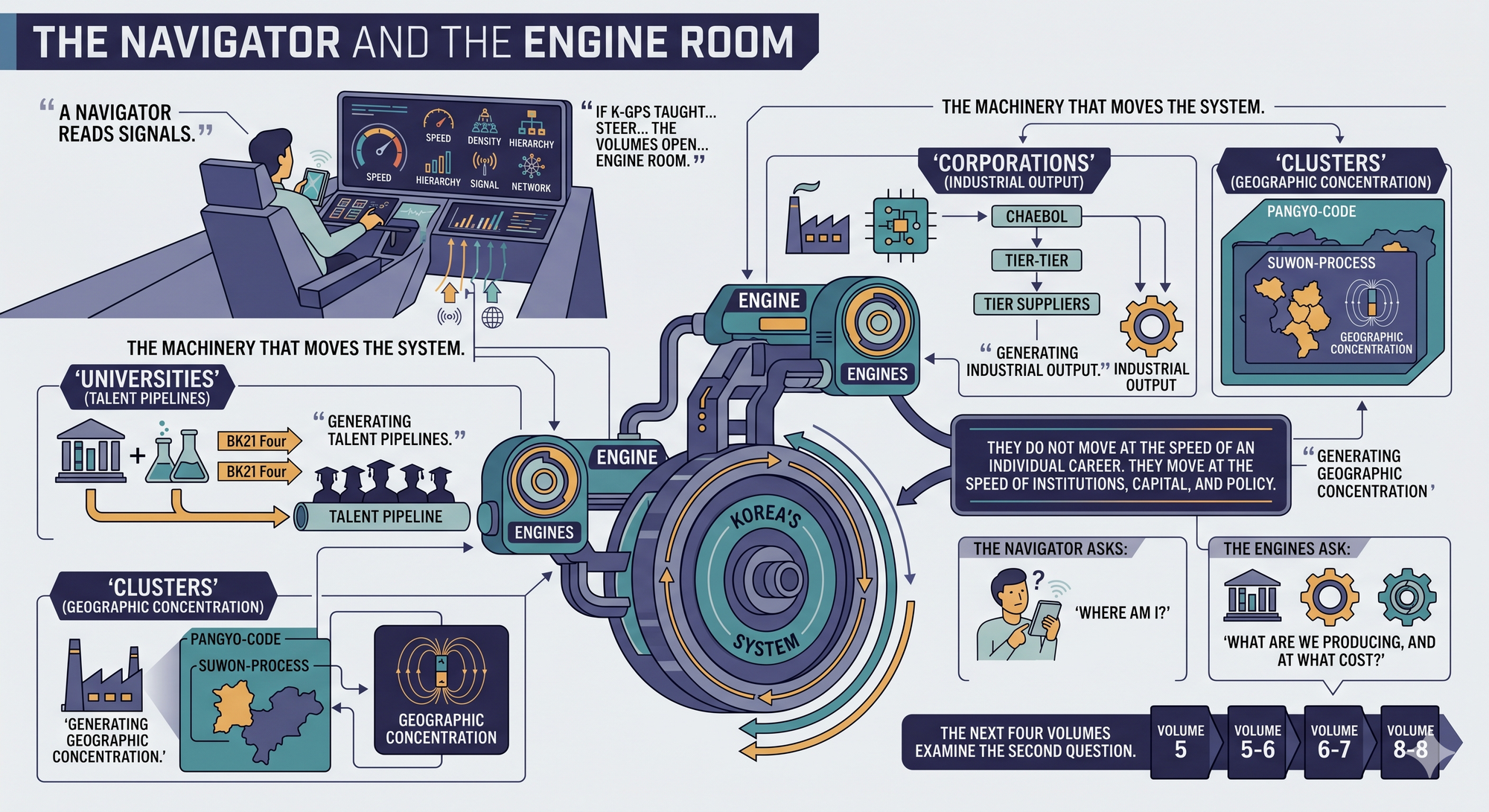
A reader’s coordinates describe where they stand in Korea’s system.
But coordinates only exist because something built the map.
Universities generate talent pipelines.
Corporations generate industrial output.
Clusters generate geographic concentration.
These are the engines.
They do not move at the speed of an individual career.
They move at the speed of institutions, capital, and policy.
The navigator asks:
Where am I?
The engines ask:
What are we producing, and at what cost?
The next four volumes examine the second question.
The Navigator and the Engines
K-System Decode positioned the reader as a coordinate on a map.
A reader who knows their K-GPS coordinate can choose a pathway, select a region, and navigate the administrative chains required to operate in Korea.
But every map has mapmakers.
The Pangyo cluster, for example, did not appear by accident.
Its Code grammar emerged from platform companies, corporate venture capital, KAIST-trained founders, regulatory sandboxes, and metropolitan real-estate economics.
These components acted together as an engine.
The same logic applies elsewhere.
The KAIST a reader enters is produced by a research engine — funding structures, returning diaspora flows, conscription constraints, and specialized graduate programs.
The Samsung a reader applies to is produced by a corporate engine — supplier tiers, governance structures, export-control exposure, and industrial policy.
These engines produce the signals the navigator reads.
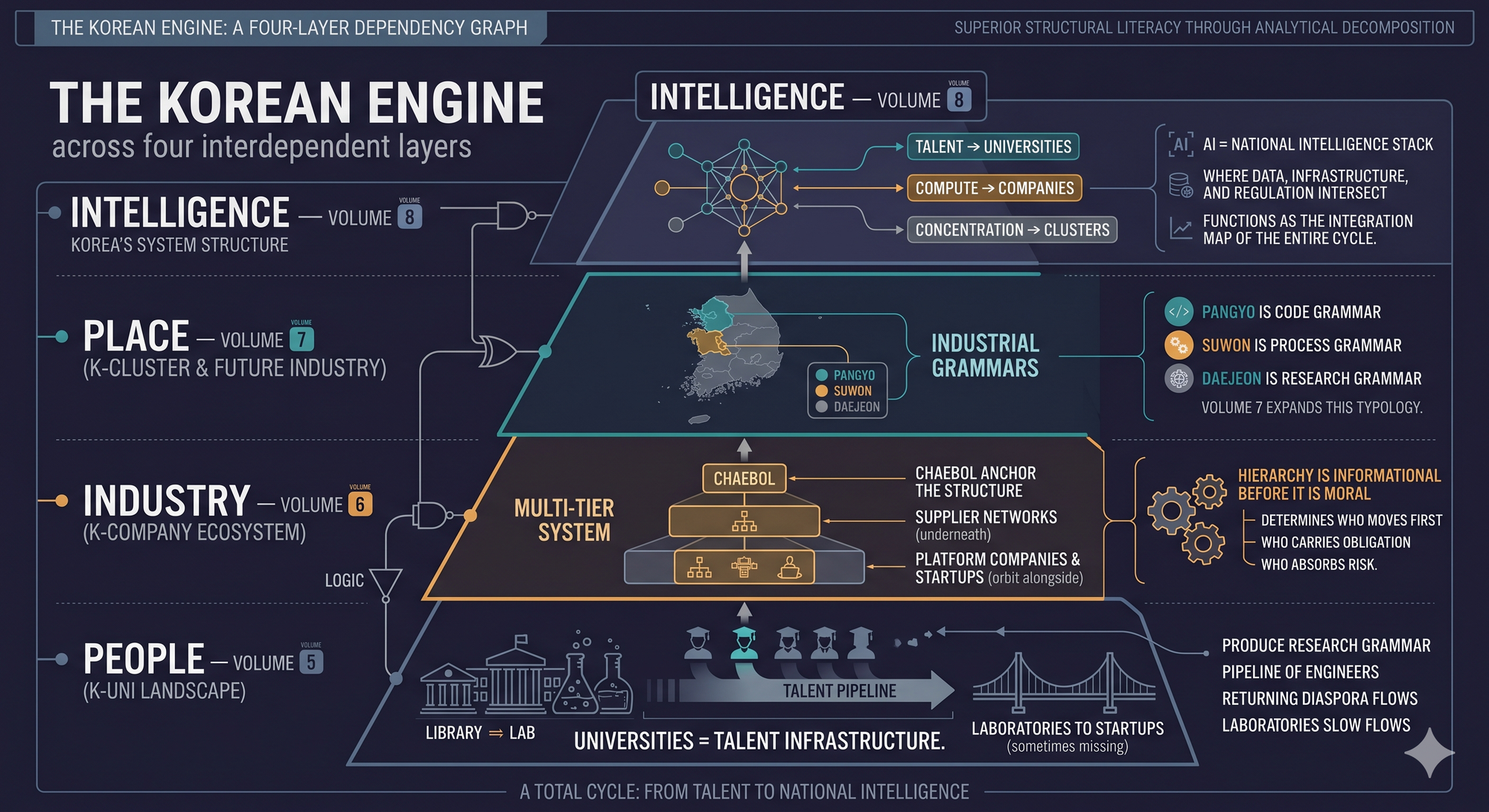
The scale changes.
K-GPS describes the individual.
The volumes ahead describe institutions.
The time horizon changes.
Visa runways are measured in months.
Clusters, firms, and universities move across decades.
The reader’s role changes as well.
K-System Decode gave the navigator a coordinate.
The next volumes reveal the engines that produced the map.
A navigator learns where they stand.
A structural reader learns what produces the map.
The volumes ahead move from coordinates to engines.
Dawn Chang, PhD · Editor-in-Chief, K-Welle · editor@k-welle.com